This is the blog for Horticulture 318: Applied Ecology of Managed Ecosystems at Oregon State University.
Wednesday, September 26, 2018
Going up the Country
The National Park System is one of America's great ideas. They have preserved a significant chunk of our natural history for us and future generations to enjoy. Despite the protections they have, National Parks are not immune from existential changes we are causing to the earth system during the Anthropocene. This Washington Post article summarizes a recent scientific study that suggests that climate change has had a disprortionate impact on our national parks. This is partly becauese many of our parks are in the arctic and the western US, two regions that have so far experienced the most dramatic climate changes.
Wednesday, April 18, 2018
Soil!
Our conversion of landscapes such as forests and wetlands into various forms of domesticated landscapes such as row crops, managed pastures, and cities has been a major source of our greenhouse gas emissions as well as contributing to the ongoing imbalance between carbon sequestration and carbon flow to the atmosphere and oceans. This long article in the New York Times explores the role that soils play in this as well as efforts and ideas for improving carbon storage in our agricultural soils.
https://nyti.ms/2HcQ6d2
Monday, April 2, 2018
Footprints in the sand
Archeologists working along the shore of British Columbia have found the oldest known footprints in North America. The image above is from a NYT article describing the find: https://www.nytimes.com/2018/03/28/science/footprints-oldest-north-america.html
The article has a link to the actual scientific article that was published in PLOS One laste week.
The find adds a bit of evidence to the still contentious idea that the first human colonists to North America arrived via boat, takeing advantage of the rich coastal marine resources along the Pacific Coast of North America. The hypthesized route has been called the "kelp highway".
Thursday, October 12, 2017
Plugging Holes
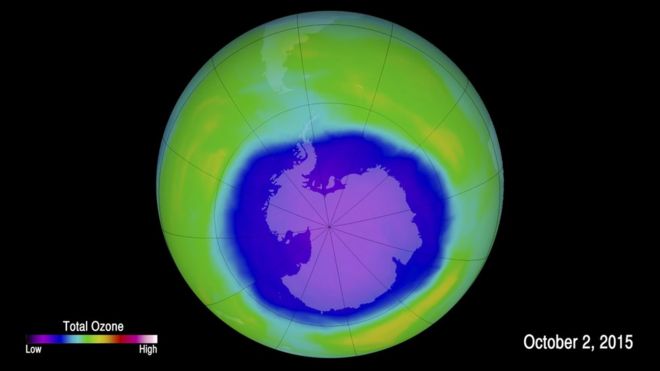
The process that allowed us to came together as a global society to address the depletion of earth's ozone layer is one of the great success stories of ecosystem management. First scientists provided a clear and unambiguous warning about the threat and what was causing it. Policymakers, governments, and private industry used that information to design practical solutions and to implement them. Governments came together and took collective and decisive action to support those solutions. That culminated 30 years ago in the signing of the Montreal Protocol, which helped us phase out the use of chlorofluorocarbons and hydrochlorofluorocarbons that are the main enemies of stratospheric ozone.
However, check out this BBC story about the rise of other compounds that are beginning to have a detrimental affect http://www.bbc.com/news/science-environment-41585552
One of the main ones is dichloroethane that is used in the manufacture of polyvinyl chloride (PVC). PVC is everywhere. Agriculture, is one example where it is increasingly being used for things like irrigation pipe, green houses, and row covers among other things.
This news story is based on a recent scientific paper. Check out the original source here:
https://www.atmos-chem-phys.net/17/11929/2017/
Also note that there is still scientific controversy about this. Unlike the case when the Montreal Protocol was signed
Tuesday, September 19, 2017
http://www.pnas.org/cgi/content/long/1702078114v1
The lead author, William Ripple, is from OSU.
This is from the Significance section of the article:
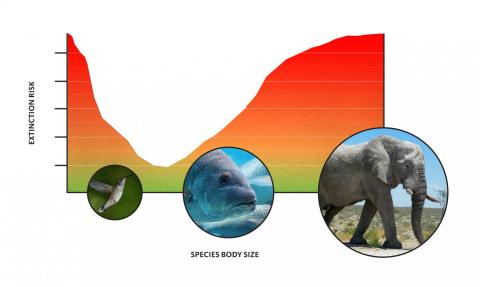
Determining the drivers of extinction risk has been a key pursuit of conservation biology. Considering that body mass could be a strong predictor of extinction risk, we constructed a global database of body masses for 27,647 vertebrate species. Results show that the smallest- and largest-bodied vertebrates have elevated extinction risk. The largest vertebrates are mostly threatened by direct killing by humans, whereas the smallest species are more likely to have restricted geographic ranges—an important predictor of extinction risk—and be threatened by habitat degradation. Declines of large and small vertebrate species will truncate the size distributions characterizing these taxa, jeopardizing ecosystem services to humans, and generating cascading ecological and evolutionary effects on other species and processes.
Monday, April 11, 2016
Strange Brew
While we have made great strides in improving drinking water
quality around the world, incidents like the crisis in Flint Michigan http://nyti.ms/1RuBB29 indicate that access
to safe water can still be an issue even in the most developed countries. Access to safe drinking water is probably most tenuous in parts of the developing and recently developed world.
Check out this news story from the NYT reporting on recently released Chinese water pollution
statistics: http://nyti.ms/25UCOFi The headline statistic is that over 80% of the tested groundwater wells is unfit for bathing.
Tuesday, February 9, 2016
The World Tomorrow
Despite (or perhaps because of) how adaptable humans are, we tend to have a hard time planing for the future. This hinders our ability to grapple with issues that have no or few immediate impacts, but that potentially have big long term ones. Climate change is one of these issues. Even climate scientists and policy makers who are thinking about the long term impacts of climate change tend to have a short frame of reference relative to the history of life on the planet. A paper that just came out in Nature Climate Change, tries to broaden our time horizon a bit. It summarizes some of the predictions for what a warmer world (caused by us now) will look like 10,000 years from now. You can read the actual article here: http://www.nature.com/nclimate/journal/vaop/ncurrent/full/nclimate2923.html
and a news summary from the Washington Post here:
http://wpo.st/JBGA1
That story has a cool video from NASA showing actual data on the more recent sea level changes that have already happened over the last 23 years.
Subscribe to:
Posts (Atom)