Thursday, January 17, 2013

The Diversity Within


Check out this story from the LA Times that describes the miraculous treatment of a common and debilitating intestinal infection using fecal transplants.  Yes, you read that correctly: fecal transplants.  This medical advance is a direct result of our growing appreciation for the immense diversity of microbes that inhabit the human body ecosystem.....and the important ecosystem services this diversity can provide. Check out these two recent scientific articles describing recent advances in our understanding of the human microbiome:
http://www.nature.com/nature/journal/v486/n7402/full/nature11234.html
http://www.plosone.org/article/info%3Adoi%2F10.1371%2Fjournal.pone.0032118

And this link to the Human Microbiome Project: http://commonfund.nih.gov/hmp/

And this cool interactive feature from Scientific American (were the picture above comes from): http://www.scientificamerican.com/article.cfm?id=microbiome-graphic-explore-human-microbiome

Saturday, January 12, 2013

Times they are a Changing


The federal government has just released a draft of the nation's third climate assessment report, a comprehensive analysis of the latest and best peer-reviewed science on the extent and impacts of global warming on the United States.  The conclusions aren't very reassuring.  The country is hotter than it used to be, rainfall is becoming both more intense and more erratic, and rising seas and storm surges threaten U.S. coasts.  Also,the assessment warns that with the current rate of global carbon emissions, these impacts will intensify in the coming decades.

The global policy response to this looming threat has so far been an abject failure.  And the recent performance of our own national government in dealing with the relatively mundane and simple task of agreeing on a budget for next year does not offer much hope that nations will cooperate to take any meaningful action on climate change any time soon. Yet, humans are capable of fixing large looming global problems when they set their mind to it.  The most recent example has been the international response that curtailed the use of Chlorofluorocarbons, which were eating away at the earth's protective ozone coating.  The latest data suggest that as a result of this international effort ozone in the upper atmosphere is on the mend.  We were able to act  in time to keep our ozone; will we act in time to avert catastrophic disruptions to our climate? 

Saturday, December 8, 2012

Dont waste time on the internet


Want to contribute to science without donating a body part or spending years of your life trying to find meaning in inscrutable sets of numbers? Then I can help! A group of OSU students are designing a sustainable landscaping WebApp to compete in a sustainability design competition sponsored by the EPA. By taking a few moments to complete our online survey you can provide us with information that will inform our design process and help make our WebApp as useful and relevant as possible. If you are interested, please follow this link to the online survey as well as more information about the project:
http://oregonstate.qualtrics.com/SE/?SID=SV_8oVpoM9V89ske1f

Sunday, November 18, 2012

The Dust Bowl


A couple weeks ago I  asked you to watch a documentary on the Dust Bowl that aired on the American Experience.

Tonight PBS is airing another documentary on the Dust Bowl, this one by Ken Burns.  As Donald Worster says in the preamble to the movie, the Dust Bowl is one of the greatest human caused ecological disasters of all time.  It is a good idea for all of us to learn its lessons.

Monday, November 5, 2012

What's on Tap for Week 7


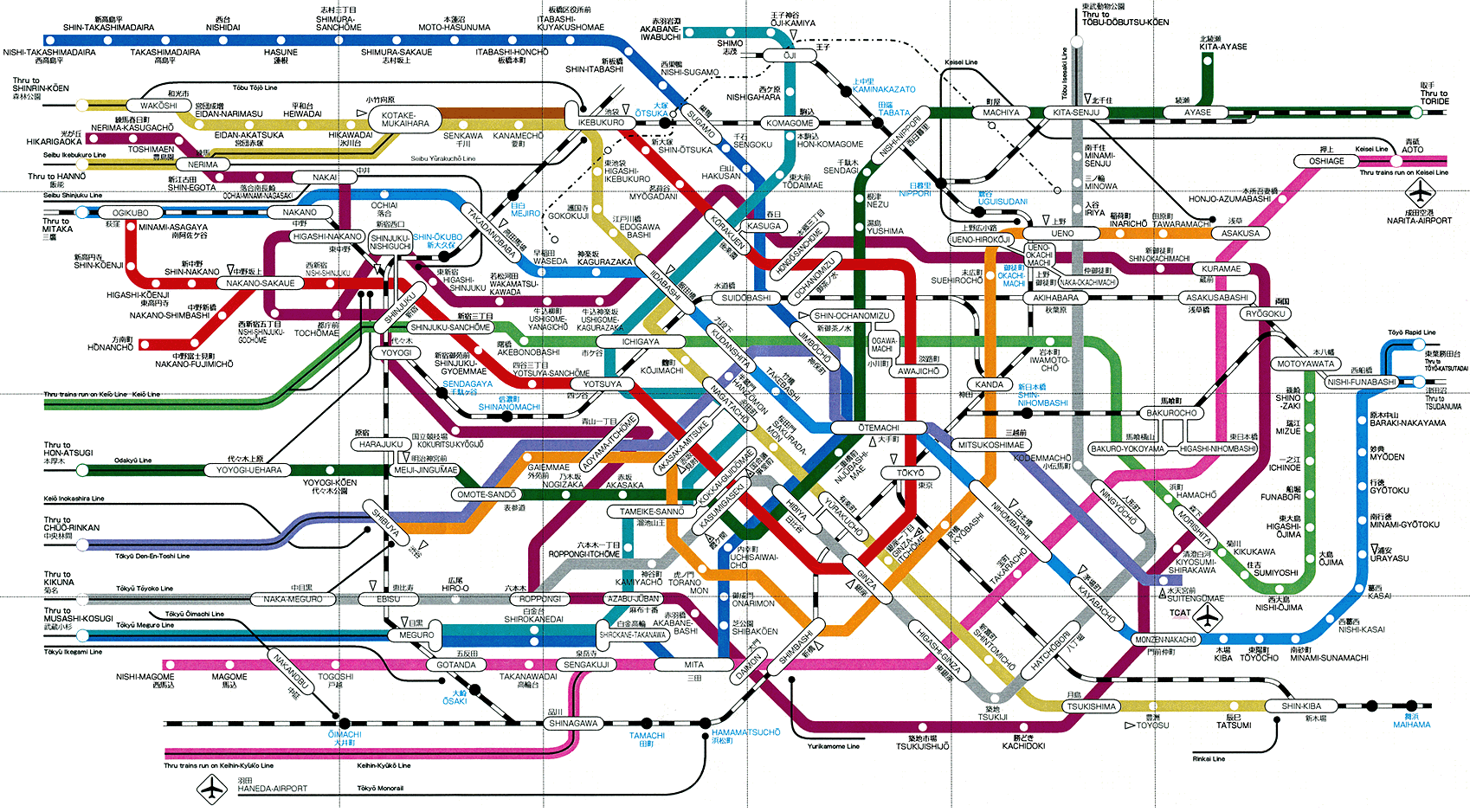
I am currently in Tokyo, one of the most densely populated and resource use intensive cities on the planet.  But much like Chicago, where I was a couple of weeks ago, Tokyo is a leader in developing a sustainable urban life.  One example of this public transportation.  The Tokyo Metro is but one part of of one of the most comprehensive and integrated systems on the planet.  I have so far not had to wait more than five minutes for a train!

We will talk a bit more explicitly about urban systems in the next week.  This week, we take a closer look at pest management.  We spend a considerable amount of effort dealing with pests....effort which translates into energy use and many practices that have a profound impact on the ecology of the planet, not to mention our own health.  The  lectures this week explore the ecological concepts that are fundamental to pest management, and they also explore ways that we can use an understanding of ecology to lessen the resource use and environmental impacts associated with pest management.  The readings carry on that theme....and include some fun videos about parasitoid wasps!

In the homework assignment I have you explore a simple mathematical model that describes populations of predators and their prey.....the basic thing we are trying to manage when we do pest management.  You should go over the lectures before trying the homework.


Monday, October 22, 2012

What's on tap for week 5


No video this week.  I have a nasty cold that involves laryngitis.  The laryngitis and the fact that I am barely presentable even when I am fit and hale made me refrain from showing you my sickly mug...here is a shot of me in healthier, happier times.

This week we continue our exploration of the nebulous concept of sustainability.  Last week I gave you a definition of what sustainability is using broad ecological concepts.  But can we translate those broad concepts into something more practical….something that could say help us design a more sustainable agricultural system?  The lectures this week explore this more practical side.  While it is only a brief overview, I hope the lectures give you a sense of some of the ways that people are trying to apply the sustainability concept…as well as some of the challenges.  The lectures conclude with a discussion of perhaps the most practical agricultural sustainability consideration of them all: soil conservation.  The documentary “Surviving the Dustbowl” continues that theme.  It is a loose adaptation of this fantastic book: “The Worst Hard Time
The other readings consider different ways of achieving agricultural sustainability.  Note the longish webinar on no-till systems is optional.

For the homework assignment I have you set up an outline for doing a Life Cycle Assessment. 

Have a great week, and I hope nobody is sick!

Thursday, October 18, 2012